Artificial: How to Read the Fine Print — Trade Buyer Briefing
VapeWholesaleHub Artificial · Artificial flavour development
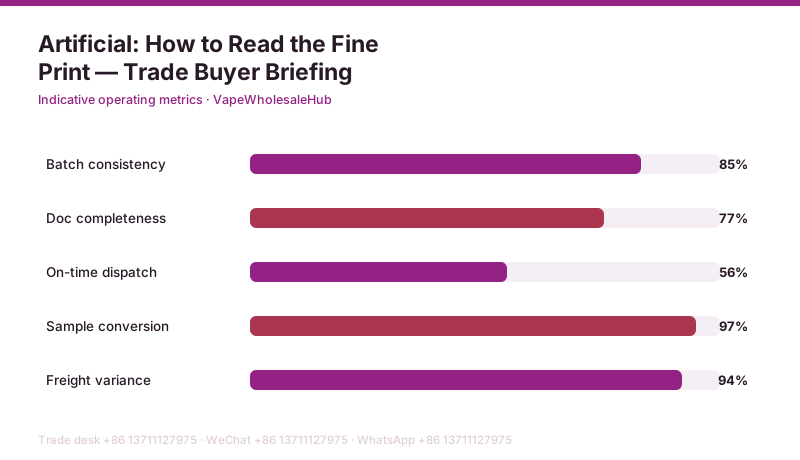
There is a version of artificial: How to Read the Fine Print — Trade Buyer Briefing that exists in supplier decks, and there is the version that shows up on a warehouse floor at 7am when a shipment is short by two cartons. We spend our time in the second version. Below is what we have learned handling artificial: How to Read the Fine Print — Trade Buyer Briefing for wholesale accounts.
Freight, packaging and landed cost
Logistics decides whether artificial: How to Read the Fine Print — Trade Buyer Briefing is profitable more often than product quality does. A three day saving on a freight route is worth more per unit than most price negotiations, and it is usually easier to achieve. Mode choice, consolidation and customs pre-clearance are where the margin actually lives.
Packaging is part of logistics, not marketing. Cartons for artificial: How to Read the Fine Print — Trade Buyer Briefing need to survive stacking, humidity and a forklift operator having a bad Monday. We specify board grade and pallet pattern before we talk about print finish, because a damaged pallet costs more than any artwork upgrade recovers.
What quality control looks like in practice
A quality system for artificial: How to Read the Fine Print — Trade Buyer Briefing should produce a number someone is accountable for. Defect rate per batch, days to resolution, repeat complaint rate. Without a number, quality becomes an opinion, and opinions do not survive a busy quarter.
The failure modes in artificial: How to Read the Fine Print — Trade Buyer Briefing are predictable once you have seen enough of them. Seals that relax in heat, tolerances that drift after a tooling change, inputs that separate in transit. Testing for the known failure modes catches roughly ninety percent of what would otherwise reach a customer.
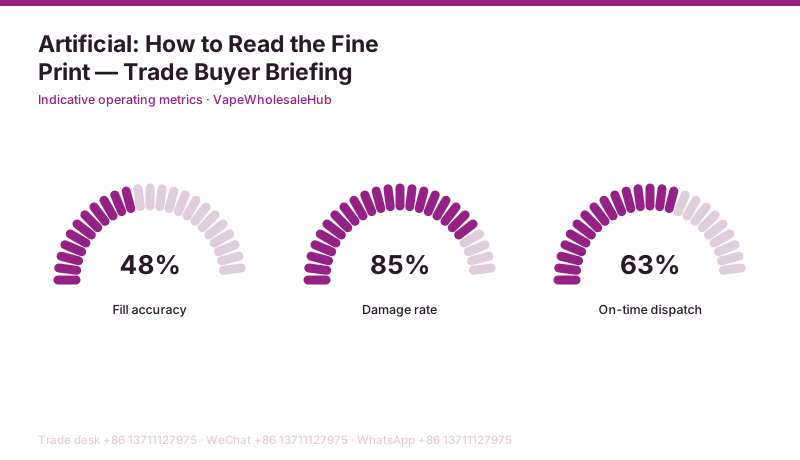
The commercial side of the decision
Commercially, artificial: How to Read the Fine Print — Trade Buyer Briefing rewards buyers who think in turns rather than in unit cost. A slightly higher price on a line that sells through twice as fast is better money than a cheap line that occupies shelf space and working capital for two seasons.
The accounts that grow steadily on artificial: How to Read the Fine Print — Trade Buyer Briefing tend to do one boring thing well: they reorder before they run out. It sounds obvious. In practice, most wholesale buyers reorder late, pay for expedited freight, and then blame the supplier for the cost.
Documentation and regulatory reality
Buyers sometimes treat compliance for artificial: How to Read the Fine Print — Trade Buyer Briefing as a cost to be minimised. It reads better as a moat. When the market tightens, the accounts that already hold complete technical files keep trading while everyone else scrambles to produce paperwork that should have existed a year earlier.
Compliance is where artificial: How to Read the Fine Print — Trade Buyer Briefing either holds together or quietly falls apart. Regulators are not interested in intent; they want documents that match the physical goods. If the label says one thing and the test report says another, the shipment is the problem, not the paperwork.
Order structure at a glance
| Item | Standard | Volume | Programme |
|---|---|---|---|
| Typical order unit | Master carton | Pallet | Full container |
| Documentation | COA + SDS | COA + SDS + batch record | Full technical file |
| Lead time | 2-4 working days | 5-10 working days | 15-25 working days |
| Customisation | Label only | Label + closure + bottle | Full OEM / ODM |
| Sampling | Charged, credited on order | Included in development | Multi-round approval |
| Indicative MOQ | 300 units | 1,500 units | 6,000 units |
| Development window | n/a | 5-8 working days | 5-8 + approval |
Common questions
How are samples handled?
Sample packs are charged at cost with the shipping borne by the buyer, and the amount is credited against your first bulk order. That keeps sampling serious and avoids the delays that come with an open-ended free sample programme.
Which payment methods do you accept?
We accept bank wire transfer for most wholesale accounts, with card and digital payment options available for samples and smaller orders. Established accounts can apply for credit terms after a trading history has been established.
What is the usual minimum order quantity?
Minimum order quantity depends on the line. Standard stock items typically start at a single master carton, while custom work, private label artwork and bespoke tooling carry higher thresholds because the setup cost has to be recovered. We publish the figure for each line rather than quoting one blanket number.
Related reading
- Artificial: Evaluating Total Cost of Ownership — Regional Depot Guide
- Artificial and recipe iteration: Notes From the Trade Desk — Export Market Guide
- Artificial and Minimum Advertised Pricing — Regional Depot Guide
- Artificial: Import Broker Relationships — High Volume Planning
- Artificial Vape Supply Notes 553
- Artificial: How to Read the Fine Print — Retail Chain Focus
Talk to the wholesale desk. Specifications, MOQ, stock and freight options for artificial: How to Read the Fine Print — Trade Buyer Briefing.
Phone +86 13711127975 · WeChat +86 13711127975 · WhatsApp +86 13711127975